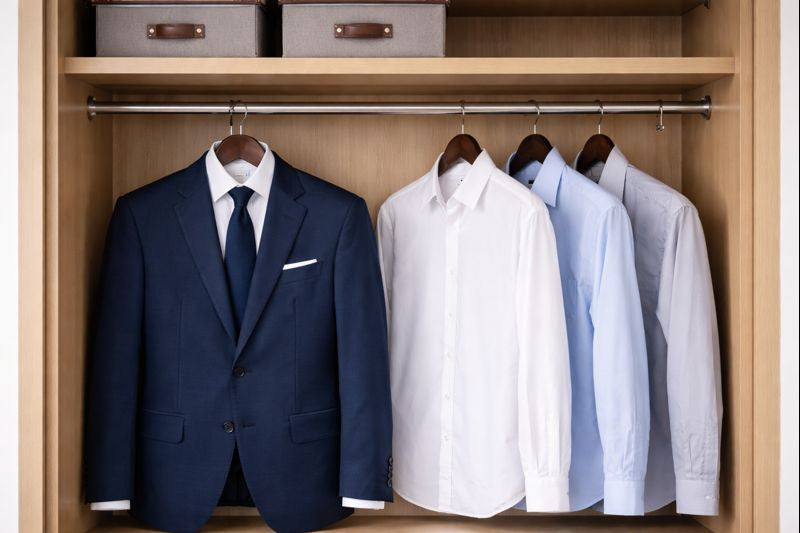
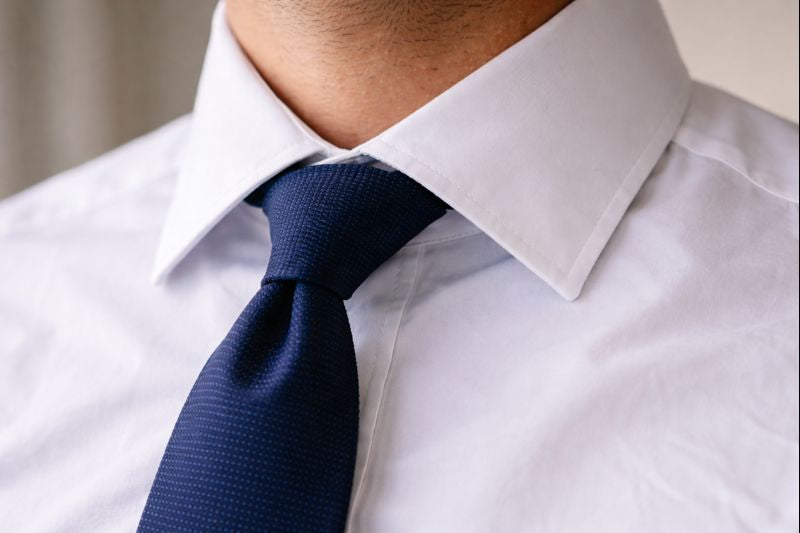
This question sounds simple until someone says, “Wear a button-down,” and another person shows up in a stiff white shirt ready for a tie, while someone else brings an Oxford that looks like it belongs at brunch. Some are being worn with suits and other untucked, so what’s the deal?
The confusion is real because these terms describe different things. One is about formality, one is about how the shirt closes, and one is about a specific collar feature. Once that clicks, the naming gets easy.
Why these terms get mixed up
Most people use “button-up” and “button-down” interchangeably. Retailers do not help, since some stores label almost any collared shirt with buttons as a “button-down,” even when the collar points do not actually button.
Add “dress shirt” into the mix and now there are three labels floating around, each with different rules. Here is the clean way to sort them.
Dress shirt: a shirt built for tailoring
A dress shirt is a shirt designed to look right with tailored clothing. Think suits, sport coats, and formal trousers. It can still be worn casually, but it is made with a more refined job description.
What usually makes a shirt a dress shirt:
-
A more structured collar that holds its shape, especially under a jacket
-
Smoother fabrics that look crisp, like poplin, broadcloth, or twill
-
A longer hem that is meant to stay tucked
-
Cleaner details, such as a standard placket and more subtle stitching
Dress shirts also tend to have a more “finished” look in the collar and cuff. That does not mean every dress shirt is stiff or formal, but the design is aimed at polish first.
Button-up: the broad umbrella term
“Button-up” is the simplest term of the three. It means the shirt buttons up the front. That is it. It does not automatically mean formal or casual.
A button-up can be:
-
A crisp dress shirt
-
A casual flannel
-
A linen summer shirt
-
An Oxford
-
A denim work shirt
If the front closes with buttons, it is a button-up. So yes, a dress shirt can be a button-up.
Button-down: a collar detail, not a dress code
This is where most people get tripped up.
A button-down is not about the front of the shirt. It is about the collar. A true button-down shirt has buttons that fasten the collar points down to the shirt.
How to spot a real button-down quickly:
-
Look at the collar tips
-
If there is a small button on each collar point, and a corresponding buttonhole, it is a button-down collar
That is the whole definition.
So here is the line that ends the debate:
A button-down is a type of button-up, but not every button-up is a button-down.
Does a button-down mean casual
Most of the time, yes. Button-down collars started as a sport detail and they still read more relaxed than a spread collar or a cutaway collar.
That does not mean a button-down looks sloppy. It can look sharp, especially in an Oxford cloth with a clean fit. But it is usually not the first choice for the most formal situations.
If the goal is a suit-and-tie look for a wedding, interview, or formal event, a standard dress shirt collar typically makes more sense than a button-down collar. Button-down collars can work with tailoring, but the vibe is more business casual than formal.
Where Oxford and OCBD fit in
Oxford is a fabric. It describes a slightly textured weave that feels sturdier and more casual than a smooth dress shirt fabric. People love it because it is breathable, forgiving, and looks better than a tee with almost no effort.
OCBD stands for Oxford Cloth Button-Down. That term is popular because it tells you two things at once:
-
The fabric is Oxford
-
The collar is button-down
An Oxford shirt is often a button-down, but it does not have to be. You can find Oxford shirts with different collar styles. The key is not to assume. Look at the collar points.
Dress shirt vs casual button-up: how to tell what you are looking at
If you are standing in a store or scrolling online and trying to figure out what category a shirt belongs to, use these cues.
Fabric: smooth vs textured
-
Smooth fabrics like poplin and broadcloth usually lean dressier
-
Textured fabrics like Oxford, flannel, chambray, and denim usually lean casual
Collar: structured vs relaxed
-
Dress shirts often have a crisp collar that stands up cleanly
-
Casual shirts often have softer collars that fold more naturally
Cuffs: refined vs rugged
-
French cuffs are strongly dressy
-
Barrel cuffs can be either, but dress shirts often look cleaner in the finishing
Hem: meant to tuck or meant to wear out
-
Dress shirts usually have a longer, more curved hem designed to stay tucked
-
Casual shirts are often shorter and sometimes straighter, making them easier to wear untucked
No single detail decides everything, but when three or four cues point the same direction, you have your answer.
What to call it so people actually understand you
If the goal is clear communication, use the term that matches what you mean.
-
Say “dress shirt” when the occasion is formal or you expect it to be worn with tailoring.
-
Say “button-up” when you just mean a collared shirt with buttons and you do not want to specify formality.
-
Say “button-down” when you specifically mean the collar points button down.
If you want to be even clearer, describe the collar style in one extra phrase. “Dress shirt with a spread collar” is hard to misunderstand. “Oxford button-down” is even clearer.
Common misconceptions worth clearing up
-
A button-down is not the same thing as a button-up. It is a specific type.
-
An Oxford shirt is not automatically a dress shirt. It depends on the collar, fit, and how it is styled.
-
A dress shirt is usually a button-up, but calling it a button-up does not tell anyone how formal it is.
The takeaway
These terms stop being confusing once you know what each one is describing.
-
Dress shirt: designed for a polished, tailored look
-
Button-up: any shirt that buttons up the front
-
Button-down: a shirt with collar points that button down
If you remember one thing, make it this: button-down is a collar, not a category of formality. That one detail will save you from a lot of awkward “Wait, is this what you meant?” moments.