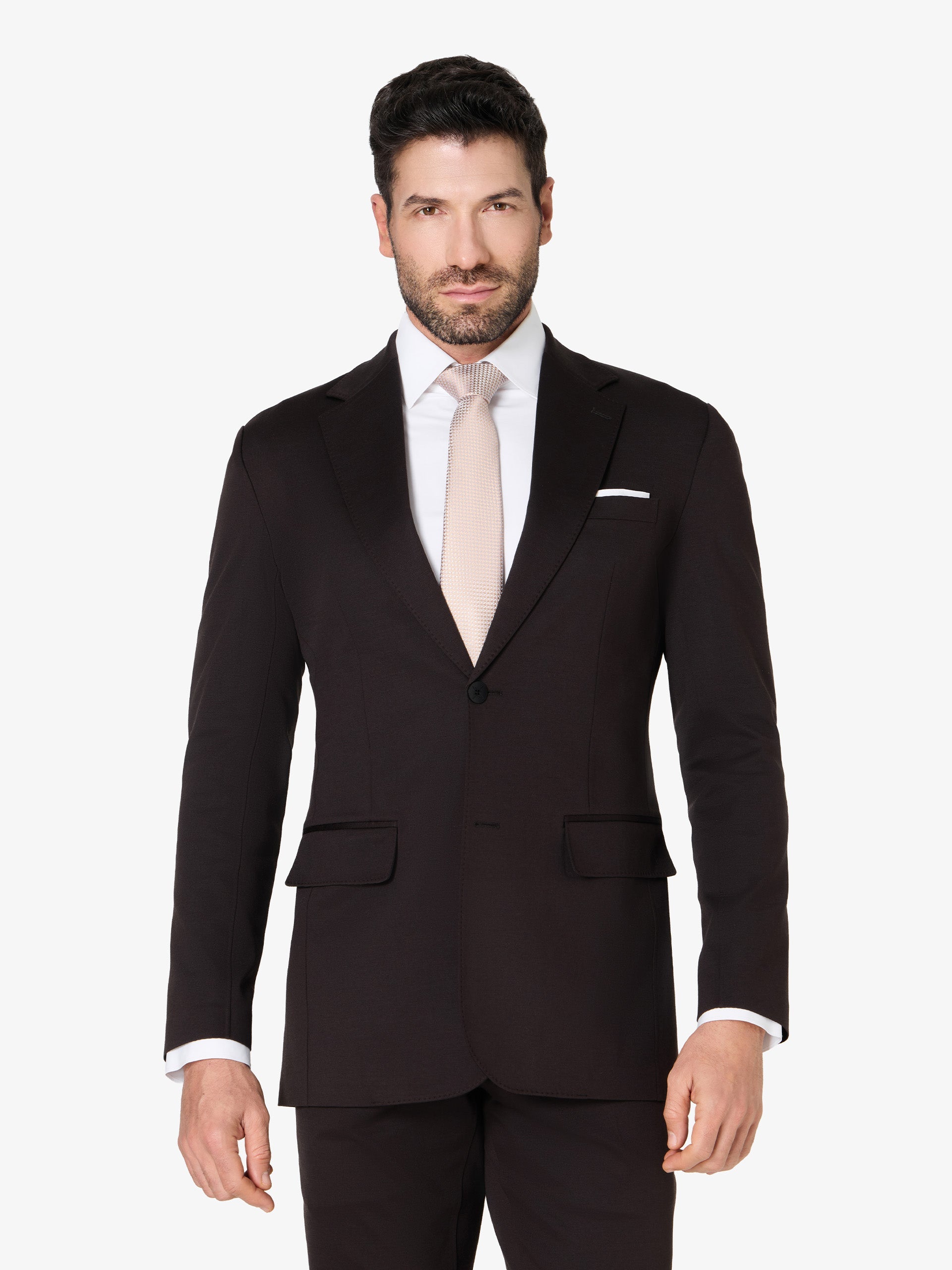
For most of suiting history, you had one option: a tailored wool jacket and pants, dry-clean only, hung carefully in a garment bag, ironed before every important meeting. That suit still exists, and for plenty of occasions it's exactly the right choice. But over the last several years, a new category has emerged that's worth taking seriously: the performance suit. It looks like a suit, fits like a suit, and is built to handle the parts of modern life that traditional tailoring was never designed for.
So how do they actually compare? Here's a practical look at where each one wins, where each one falls short, and how to think about the choice based on how you really wear a suit.
What Defines a Performance Suit vs. a Traditional Wool Suit
A traditional wool suit is built around natural fibers, structured construction, and tailored fit. The jacket usually has a canvas interior, shoulder padding, lining, and stitched seams. The fabric is typically 100% wool or a wool blend designed primarily for appearance, with little to no stretch. Care is built around dry cleaning, steaming, and occasional pressing.
A performance suit takes a different starting point. It's engineered to look like a suit while solving the problems people actually have with wearing one. That usually means stretch fabric, wrinkle resistance, stain resistance, and machine washability. Some performance suits are built from technical synthetics, while others, like the xSuit 5.0, use a wool blend (TechWool, in this case) that brings the natural feel of wool together with stretch and washability.
It's not that one is a "real" suit and the other isn't. They're built for different priorities.
Comfort and Fit: How Stretch Fabric Changes the Experience
This is the most immediate difference you'll notice. A traditional wool suit, even a well-tailored one, has a structured feel. The shoulder holds its shape, the chest has body, and the fabric itself doesn't move much. That's part of what gives a classic suit its formal presence.
Performance suits use stretch fabric specifically to remove that stiffness. Reaching across a desk, lifting a bag into an overhead bin, sitting in a car for an hour, none of these feel like an event when the fabric moves with you. Customer feedback on xSuit's product pages consistently describes the fit as athletic-feeling but professional-looking, which captures the tradeoff well: you give up some of the structured authority of a classic suit and gain a lot of all-day wearability.
If your suit days are long, active, or unpredictable, that's a meaningful difference. If you're putting it on for a two-hour event and taking it off afterward, structure may matter more than stretch.
Care and Maintenance: Dry Cleaning vs. Machine Washable Suits
Here's where the gap is widest, and probably where most buyers feel the practical impact day to day.
A traditional wool suit needs careful handling. That typically includes:
-
Dry cleaning every several wears, which adds up in cost and time
-
Steaming or pressing between wears to release wrinkles
-
Hanging on a proper suit hanger to maintain shoulder shape
-
A garment bag for travel to avoid creasing
A machine washable performance suit changes the rhythm completely. xSuit's products are designed to be tossed into a home washer on a gentle cycle and hung to dry, with their nanotechnology helping liquids bead off the fabric so spills don't immediately become emergencies. For someone who wears a suit several times a week, this isn't a small convenience. It's the difference between a suit being a maintenance project and a suit being just another piece of clothing in the rotation.
Travel and Daily Wear: Where Performance Suits Earn Their Name
If there's one use case where the performance suit gap is hardest to argue with, it's travel. Wool suits don't pack well. They wrinkle in suitcases, they need a steamer at the hotel, and they punish you if you sit on a plane in them for six hours.
Performance suits are designed around exactly this scenario. The xSuit lineup, for example, leans on wrinkle-resistant fabric so the suit comes out of a bag still looking presentable, and the machine-washable construction means a coffee spill at breakfast isn't the end of your meeting outfit. Daily commuters tend to feel a similar benefit. A suit that tolerates a backpack strap, a packed train, and a long day in a chair without looking exhausted by 4 p.m. earns its keep quickly.
A traditional wool suit can absolutely make it through a trip or a long day. It just needs more care to get there.
Style and Formality: When a Traditional Wool Suit Still Wins
It's worth being honest about where traditional wool still has the edge. For black-tie events, formal weddings, courtroom appearances, and very conservative business environments, a fully canvased wool suit with proper structure communicates something specific: occasion, formality, attention to detail. The cleanest performance suits get close, but a structured wool jacket with a hand-finished lapel still reads slightly differently to anyone who looks closely.
The other thing wool does well is patina. A great wool suit can be worn for years and develop a character that's part of its appeal. Performance suits, by design, are built to look consistent and fresh over time, which is a different goal.
If your suit is mostly a uniform for high-formality moments, traditional wool is still hard to beat. If your suit is a tool you use across a wide range of situations, performance fabric usually pulls ahead.
Cost Over Time: Looking Beyond the Sticker Price
People often compare suits at the price tag and stop there, but care costs matter. A traditional wool suit at, say, $800 can easily add $200 to $400 a year in dry cleaning and maintenance if you wear it regularly. A machine washable performance suit at a similar price has effectively zero ongoing care cost beyond detergent and your home washer.
Over three to five years, that gap closes the distance between two suits that looked very differently priced at checkout. It's worth running the math based on how often you actually wear yours.
Choosing Between Performance Suits and Traditional Wool Suits
The honest answer is that this isn't really a competition with one winner. It's a decision based on how you live in a suit.
A traditional wool suit makes sense if you want maximum formality, structured presence, and you don't mind the maintenance routine that comes with it. A performance suit makes sense if you want something you can wear often, travel with easily, and care for at home, while still looking professional in nearly every setting short of the most formal occasions.
Many people end up owning both: a traditional wool suit for the moments that demand it, and a performance suit like the xSuit 5.0 for everything else. That combination tends to cover real life better than either one alone, and it's probably the most useful way to think about the choice. The question isn't which type of suit is better. It's which one matches the way you actually need a suit to work.